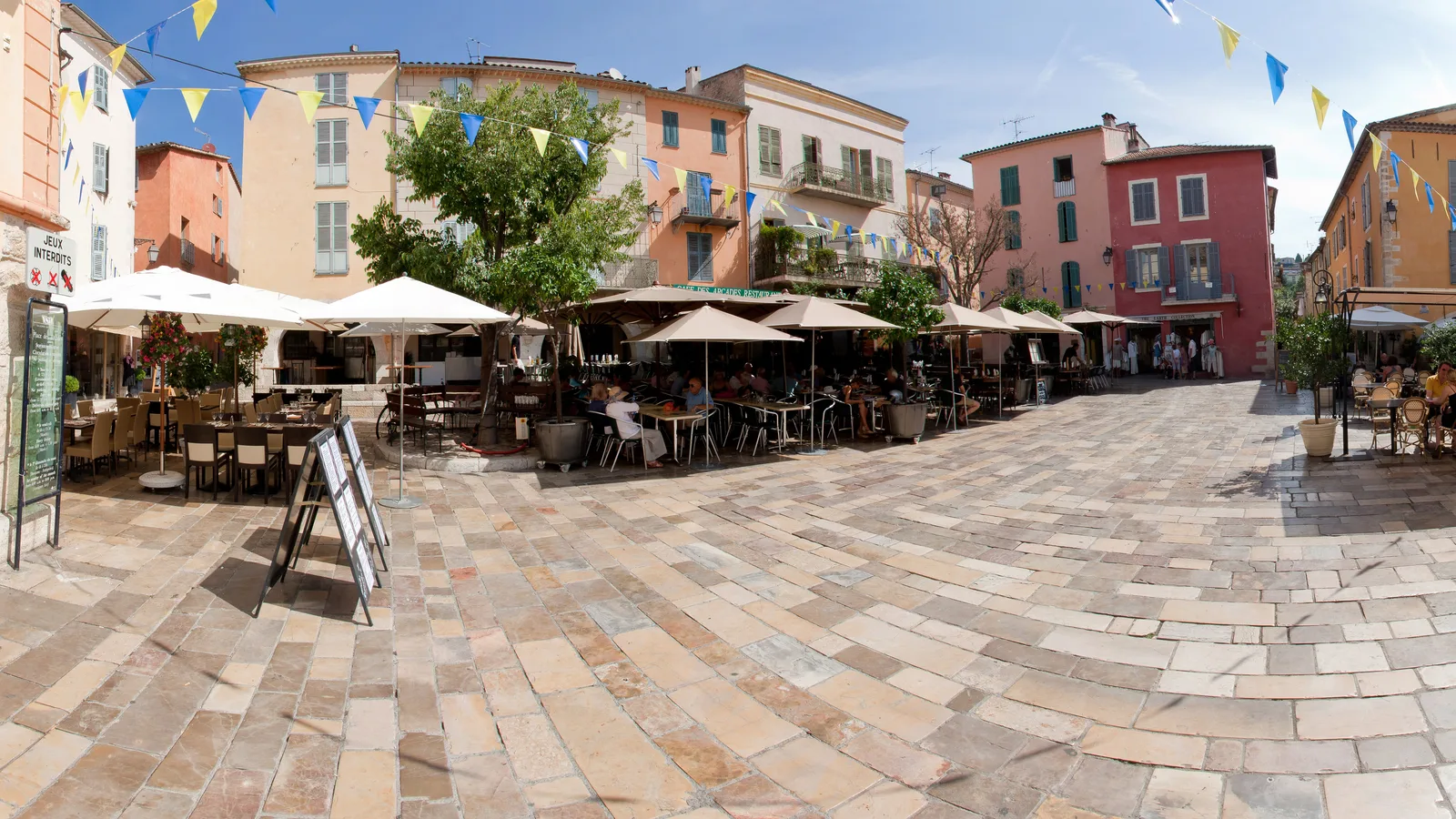
Most of the Riviera grew the way water grows — spilling downhill, finding the coast, pooling into ports. Valbonne did the opposite. It was laid out, on purpose, on a grid, by monks who wanted order on a hilltop fifteen kilometres from the sea. Five hundred years later that decision still reads on the ground: straight streets, right angles, a square at the centre where everything resolves. People call it the most un-Provençal Provençal village, which is a clumsy way of saying it was planned and the others just happened. What it gives you is rare on this coast — a village that feels deliberate rather than picturesque, lived-in rather than performed, with Sophia Antipolis humming a few minutes downhill and almost none of that showing through.
The grid, and the square that holds it
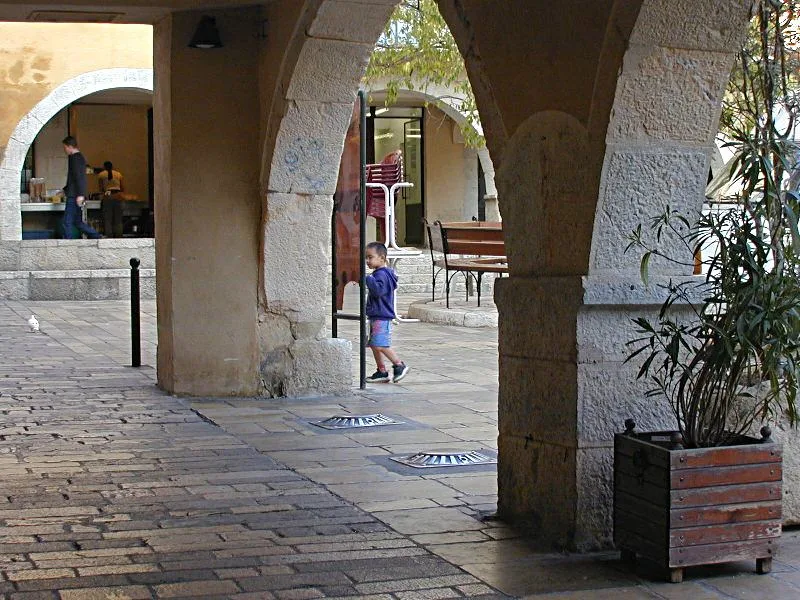
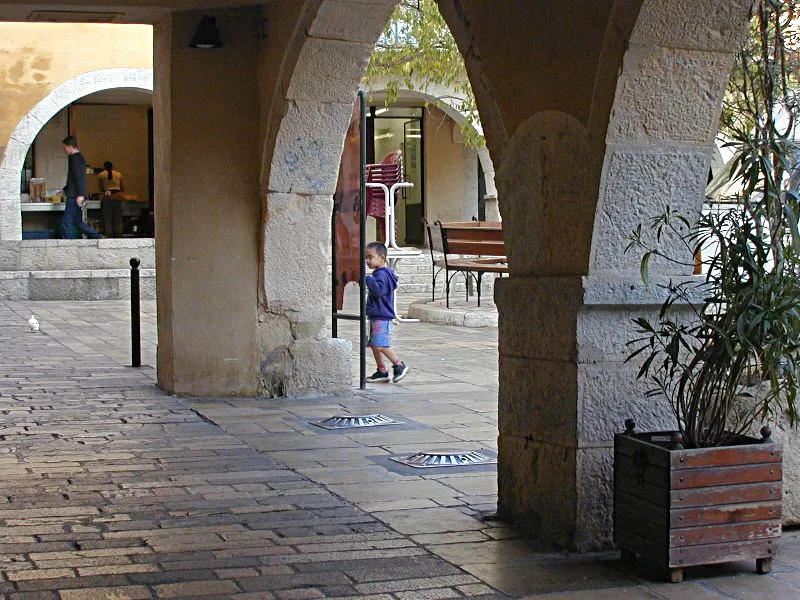
Walk in and the geometry does the work. The streets run parallel, the cross-streets meet them cleanly, and they all deliver you to Place des Arcades — a stone square ringed by arched galleries, the gravitational centre of the whole place. You don't navigate Valbonne so much as fall toward it. The arcades have held the same role for centuries: shelter from sun and rain, a colonnade to walk under, a frame for the café tables that fill the open middle.
The anchor here is Le Café des Arcades, and you should think of it less as a café than as the village's living room. The terrace runs to roughly two hundred seats under the arches; the coffee is incidental to the people-watching. It opens at half past six in the morning and closes around midnight, year-round — which means it carries the village through every hour it has. Come at seven in the evening, order a carafe of rosé, and watch the commuters thin out as Sophia Antipolis empties uphill into the bars and the dinner tables. That changeover — tech park to village, day to evening — is the most Valbonne thing there is.
A village that actually feeds itself
What sets Valbonne apart from the postcard villages is that the food is for residents, not coaches. The serious kitchen is Loulou Bleu, on Boulevard Carnot a street off the square. If you knew this address as Lou Cigalon, let it go — Chef Gilles Ajuelos (Maximin and Rostang in his lineage) rebranded it in 2019 and the old name is genuinely gone. What's there now is an open kitchen, a blue bar, and a fireplace lounge upstairs: Provence cooked with technique, in a room the village treats as its proper dinner. Book a week ahead in season.
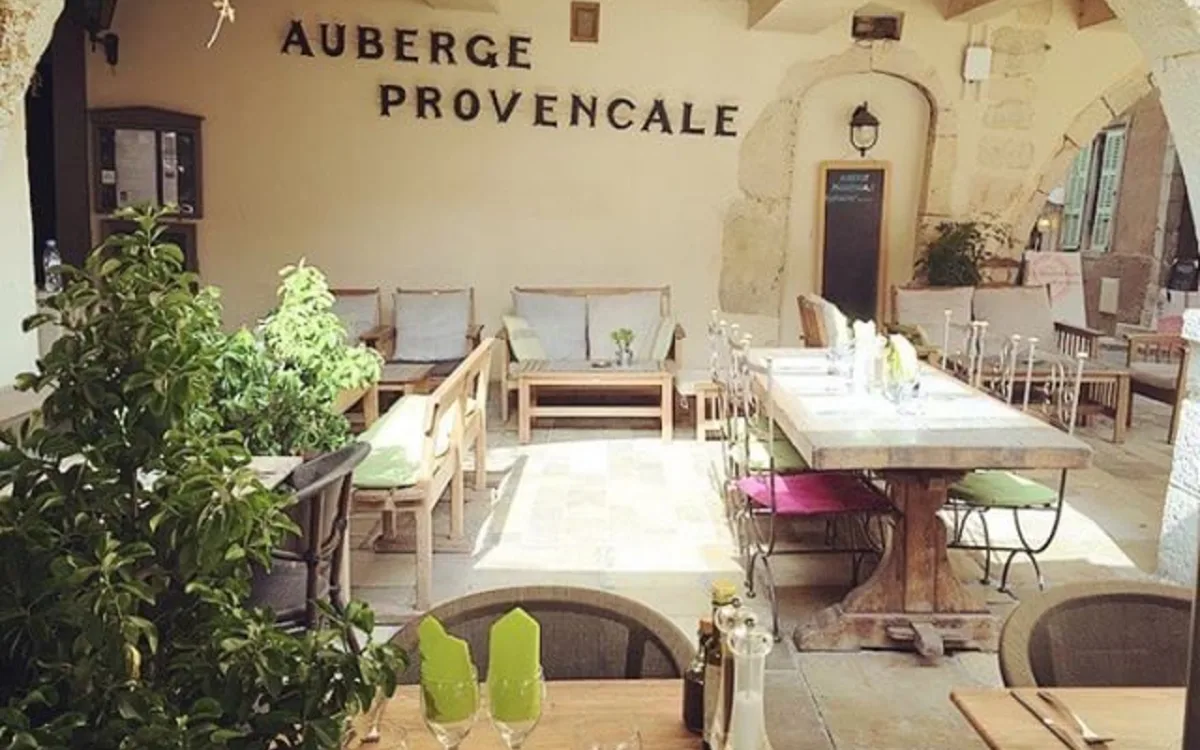
For the older register, climb the stairs at L'Auberge Provençale on Rue Émile Pourcel, above the arcades. It has been a family house since 1965, and the first-floor room — original tomettes underfoot, a fireplace working in winter — is where you want to be for a long lunch when the weather turns. It reads honestly Provençal in a way the square below sometimes works at.
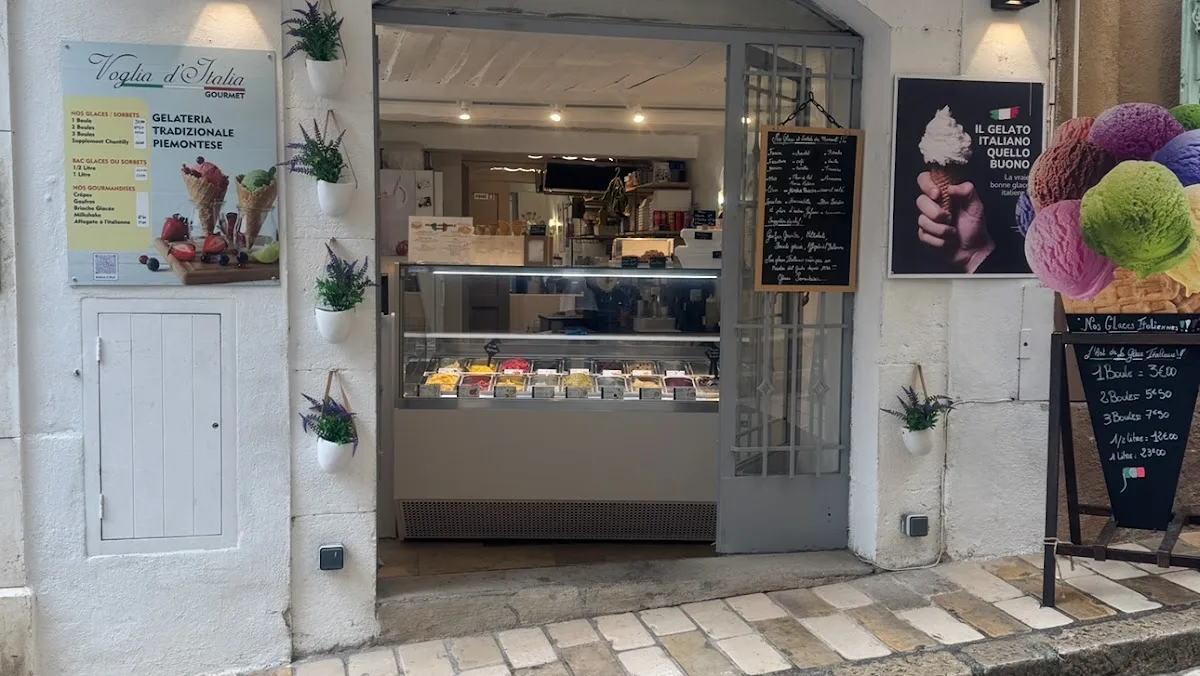
Then there are the small rituals, which is where a village earns its keep. Glacier Valbonne, three streets along on Rue Émile Pourcel, is a Piedmontese family gelateria — Turin-trained scoops at three euros, no pretending at lavender flavours. Walk a pistachio cone back to the arcades; it's a fifty-metre tradition. For mornings, Jean Luc Pelé keeps an outpost at the village edge on Place de la Vignasse — the Menton pâtissier's viennoiseries are the local standard, and a mid-morning chausson aux pommes from his oven is a fair way to begin.
What to know
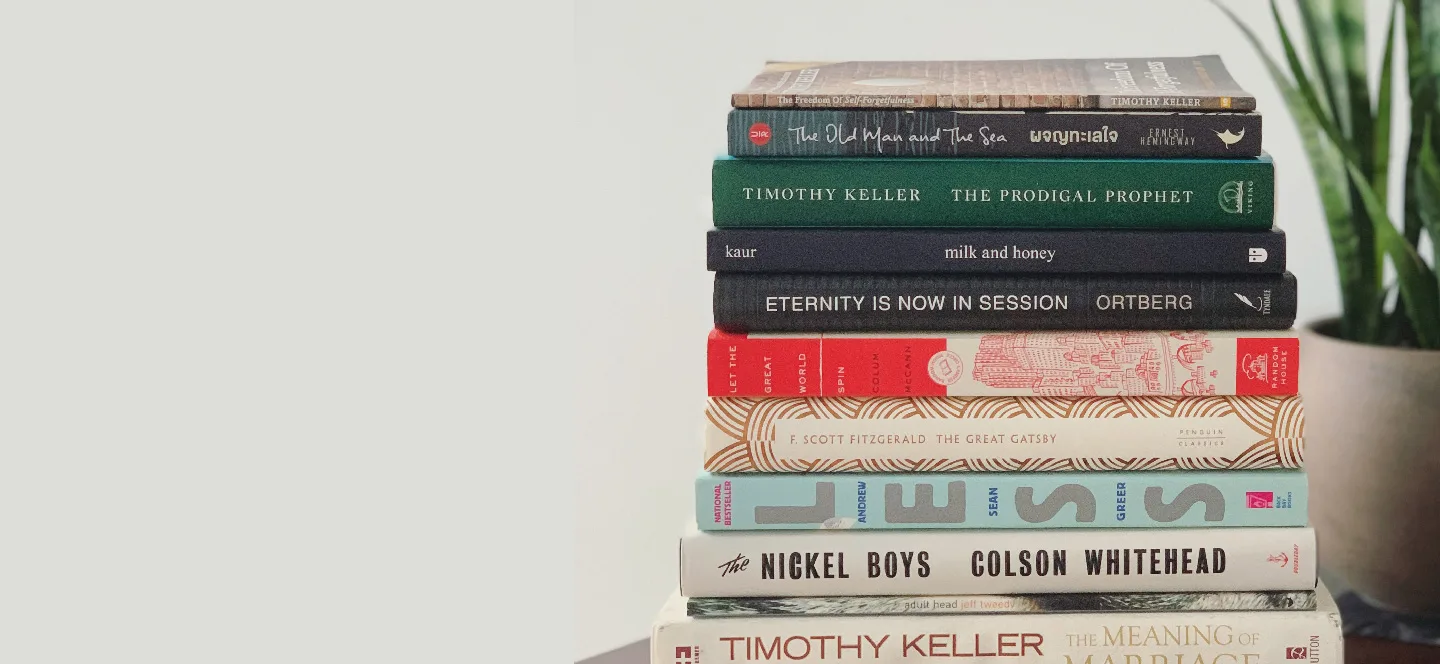
Two things shape a visit. First, the market is Friday, not Wednesday — Place des Arcades, eight to two, and it is produce rather than theatre: the village shopping for itself, with you welcome to join. Second, this is a quietly cosmopolitan place, with a long-settled British expatriate layer running underneath the Provençal one. You feel it in the bookshop — Niche Books on Rue Grande, a thirty-year English-language institution (the former English Book Centre, now under Lin Wolff), where the paperback selection is the most considered between Cannes and Nice. You feel it again after dark at The Queen's Legs Pub on Rue d'Opio, an Irish room with live music and a Thursday open-mic that pulls out the musicians who otherwise play the Sophia tech-park bars. It is the late hour Valbonne actually has, and it is the better for not pretending to be anything else. For something to carry home that isn't tat, Le Repère du Zèbre on Rue de la Brague is a 100-percent made-in-France concept store — some twelve hundred objects, sixty makers — and Margot, who opened it in 2023, is usually on the floor to walk you through the stories.
Where to stay, just outside
The village itself is small and stays small. For a base, drop fifteen minutes downhill toward Opio, where Château de la Bégude sits in the folds behind the village — a seventeenth-century bastide wrapped around an eighteen-hole golf course, old stone, a long allée of olive trees, the Riviera turned down to a murmur. The restaurant runs to Provence with technique; the Sunday lunch is a local institution and books first. This is the coast at its most restful, the kind of quiet you only get this far inland. Drive the back road from the village at dusk and you get the case for the whole area in three minutes — fields, jasmine, no traffic, the lights of Sophia behind you and the hills going dark ahead.
Valbonne won't perform for you. That is exactly the point.